Showing posts with label visual music. Show all posts

Tuesday, March 7, 2017

Romance Without Words

My final stab at this method of translating music to color was this piece by Gabriel Faure, ROMANCE WITHOUT WORDS. It is interesting that artists continually try to say the same thing in different media.
I tried to indicate a little bit of the dynamics in this piece by having the color take up more space when it was louder.  I will try this, and other pieces using this method again and not fade each note into black, as I have done so far, as this creates a line between colors and doesn't actually represent what happens to notes in a musical piece.  I think the whole thing should fade at the edges of the screen instead as the piece gradually sinks into time.

I do think these colors are rather romantic so perhaps Faure has transcended yet another medium.

Sunday, February 26, 2017

SCRIABIN

Still trying to perfect the way the colors appear on the screen I decided to see how they would look if they gradually moved down the screen while they were disappearing.  That way the viewer would see the color for a longer period of time.

I used this Scriabin Prelude because of the way it uses pauses.  This gives the colors a chance to be seen and appreciated.


Friday, February 24, 2017

Chopin Nocturne

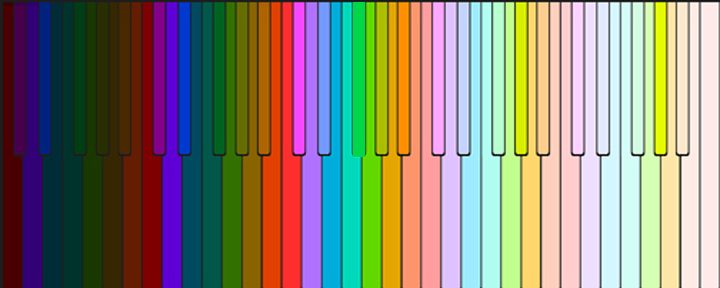
In this on going exploration of how notes can be arranged in space, still using a one to one correlation between notes and color, I kept experimenting with different music and different ways of placing the notes on the screen.  I kept the Lighter colors at the top of the screen and the darker colors at the bottom of the screen.   Then each note was programmed for a complete piece of music and this whole group became a symbol which I could then place on the screen as many times as I wanted to in any place I chose.  I wanted to duplicate the symbols so I could get more color on the screen.  This also allowed me to create unexpected patterns over time.

Here is a Chopin Nocturne.

Thursday, February 23, 2017

Claire de Lune

Now that I am free to do whatever I want with the colors in space - still keeping them tuned of course and using a one to one ratio of colors to notes - I thought I would experiment with different arrangements in the same piece of music.  This is one of my all time favorites.

CLAIRE DE LUNE
https://youtu.be/FLaFQ_ZzbIQ

Tuesday, February 21, 2017

Albinoni

Since I now was animating music that would not be so simple to design code for I figured I might as well try various methods of putting the colors on the screen.  Suppose the notes moved across the screen more or less mimicking the way we read, from left to right one measure at a time?  Here is an example of that idea with the lower notes staying put and the high notes dancing across the screen.
In the repeat of the music the higher notes stay put for comparison.

ADAGIO IN G MINOR, Thomas Albinoni


Monday, February 20, 2017

moving on

After experimenting with this method for a while I began to see some trouble having each note occupy a specific place in space.  It was fine for rounds and in Pachebel's Canon I simply allowed the notes to take up arbitrary space as it was a very simple piece.  The problem was that as music began to use a wider range of notes from high to low, in order to fit them on the screen they had to be very small.  This meant that the color interaction was not as intense and since I assume the color interaction is key to the enjoyment of color music this  presented difficulties.  In this Mozart piece I changed the arrangement of the colors in the repeat of the piece to allow more color.  It is more interesting but didn't really solve the problem for music that uses several octaves of music.
Mozart


And so I decided to abandon the idea that each color would have its own place on the stage.  This would vastly complicate a programmer's job unfortunately.  Now I decided in order to keep the colors close to each other so that they could interact with each other maximally I would place them on the screen close to each other.  I still kept them in order from light to dark but they did not have a specific place in space to call their own.  It might still be possible to design a program that would be able to interpret this arrangement but I'm not sure. I could see how it looked and hope so.

Here is the first result of that method of animating.

Chopin


Saturday, February 18, 2017

More Rounds

As you can see the rounds designed in this way do make interesting patterns.

This brings me to speculate about our ability to alter sound waves with our throat and mouth.  How about that!  We can sing.  WE are the first musical instrument.   We also can hear those altered sound waves and somehow be moved emotionally by there combined effect.  If we could alter light waves with some part of our body we could create color in time ourselves.  Since we can't do that I will continue to try to figure out how we can use modern technology to do it for us.

Going back to that exploration I animated Pachebel's Canon.  I tried to stay with classical music that is simple and popular.  I was pleased to see that these colors are quite pleasing.  There is some primitive attempt to capture dynamics by making the louder notes larger.  The music was again programmed by my grandson Luke who was then in high school and is now a lawyer.  So much goes on in a young life in a short period of time.  But of course time takes much longer when you are young.


PACHEBEL'S CANON


Friday, February 17, 2017

Back to Color and Music

Back in July I explained how I created paintings and prints by translating music to color.   I am going to take up this discussion again now.  This is more or less how I work.  For a while I paint and then I start wondering about music and color and begin to work on that again.

After making several paintings and many prints I really was itching to try to translate music to color in time.  I recognized that without an instrument that would allow someone to play colors in real time there would never be color music, but since I was unable to create such an instrument myself I decided to at least animate music in a way that could be used as a template for such an instrument.
There is a rich history of artists who designed color instruments which you can check out on Wikipedia.

However, none of these instruments has come into popular use and none of them are constructed as I would.  My theory is that any instrument must have a set of colors tuned from dark to light with a complete spectrum in each octave.


But how will the colors appear in space and time?  Each note has to be placed somewhere (space) and be played in real time.

I decided to try and translate music to color starting with the idea that the colors would be located on the screen from top to bottom with high notes being at the top of the screen and low notes being at the bottom.  Each note would be a circle of color that would diminish slowly as it disappeared.  I purchased Flash Professional CS3 and set to work figuring out how to use it.  First I had to make a file for each note.  When that was accomplished I imported music or had my grandson, Luke,  program music for me in Garage Band.

My first pieces were rounds as they are simple.  The music appears as a wavy line on the bottom of the screen in Flash under where the notes are to be placed.  In order to animate each note one must locate a change in the line and place the note at that change. It is a very tedious business.

 Each note has its own space.  Donna Nobis Pacem,  Give us Peace.

Tomorrow more rounds.


Wednesday, July 27, 2016

IPad Play

Today I went off to my second day of the Wayne Art Center's Plein Air excursion.  This time it was to the Water Wheel at the Eastern University.  I had only a little trouble finding the place as Google maps are not always exactly right I'm finding.  Since it was such a hot day I didn't think I would be capable of finishing a painting outside so I decided to take along my camera and my iPad and see if I could do something interesting with the iPad with a back up of photos to work on at home just in case.

The first thing I didn't do was bring a chair so I had to sit on the ground.  Luckily I had a mat to sit on and had sprayed for insects so it was only the problem of a possible back ache to worry about.  The second thing I didn't do was bring my iPad pen so I had to work with my finger. This is a bit clumsy as you can imagine.

I could see this was going to be some rough going but I made a few attempts at getting the scene and managed to work for 2 hours without feeling too uncomfortable.  When I got home and put the potential video into Final Cut Pro I realized it was vertical and the Final Cur Pro screen is horizontal..oops so there would be a lot of space left over on either side of the image.  I decided to simply create something with four versions of the painting, which needed all the help it could get, to see how the parts would come together.  You can't beat symmetry for interesting shapes, no matter what else is going on.  The finished product had a rather oriental look so I added this music by Kevin McLoed.

And here it is already in Youtube and ready for your viewing pleasure.
ORIENTAL GARDEN

https://youtu.be/1VjeXMZkndY


Friday, July 22, 2016

Trout Quintet, Franz Shubert

Franz Shubert in his short career, (he died when he was 31), composed a great deal of beautiful music.  Here is a link to his Wikipedia site: https://en.wikipedia.org/wiki/Franz_Schubert

The Trout Quintet is the popular name for the Piano Quintet in A major, D. 667. The work was composed in 1819, when he was 22 years old; it was not published, however, until 1829, a year after his death. 
This is a translation of the first 8 measures which only use three instruments.

Here is link to the music.  Once again the lowest part could easily stand alone. The finished piece looks and sounds like a jewel.


First Violin


second violin


Cello


Altogether


Wednesday, July 6, 2016

BACH

Finally we are up to Bach in my very truncated history of music.
I have chosen a simple piece, THE MINUET IN D minor as it is easy to see the color relationships and it is a simple but satisfying 8 measures.
Go HERE to listen to the whole piece.

Top part


Bottom part


Together


It would not be fair to present Bach without a fugue and in fact the ideas that hold a fugue together inspired a great deal of my work in fiber so next post I will present a fugue.  I have not created one yet so it may take a while.  Meanwhile I will search for a simple but beautiful one to work on.


Tuesday, June 21, 2016

Color Music

Why does the music look as it does?


You see the sheet music so you know that the first note of the piece is going to be
high D or Light purple so that goes in the center and it will take up two spaces, the next note C will take up two spaces as well, and the next, but then there is a little variation and the C or light red will only take up one space with the B taking up a half space and so it goes.  The amount of space each color takes up is determined by the amount of time each note is played.  So in affect the sheet music allows us to see a color pattern.

The top part is then placed with the bottom by dividing the parts into equal parts.  In a large piece (60" square or more) I used a 3/4 inch strip of color because it seemed to mix in the eye best when standing the usual distance from the work.  In these smaller pieces I have used very small strips of color.  Today's version has smaller strips than yesterdays and I think it works better.  I also like the rests in grey rather than white as it is more of a 'rest' instead of a stop.


PANGE MELOS LACRIMOSUM
rests in grey, smaller divisions of color

I did think these colors were beautiful together.  They were not anything I would have chosen but they really sang.  And so I began to see what other music would look like using this system of translation.

Tomorrow Mozart.

Please pass this along to anyone you think might be interested.


Monday, June 20, 2016

MUSIC

Back in the attic it was time to try a piece of music and see if the colors were beautiful together.  I decided to start with the first music I could find that was written down.  At this time I did not have a computer as it was in the 70's so I had to go to the library and see what I could see.  It was all very interesting and I discovered that although there probably was music in Egypt and Rome there is no recorded history of notation that has been found.  There is however notation from the Greeks. This is one of the most marvelous things about music, that there is notation that allows us to see exactly what notes any given composer has in mind from hundreds of years ago and reproduce the music today.

Here is eight measures of the music I chose and the translation of all the words.  You might like to listen to the music as you read the words.  You'll notice that all the notes are very close in tone, nothing very high or very low and the notes flow into each other without a pause.  This is typical of early music.  It holds together because of the tones, rhythm is not very important.

https://youtu.be/FZK4OFPEqEg

Compose a tearful melody,
weeping in elegy;
a time for lamentation has come,
a time that steals joys.
At this eclipse sorrow’s night
distorts what we see;
Let sadness rule, for the
cause of sorrow stands in the watchtower.
The star of the Rhine
casts Latium into ruins;
the star tumbles, and the star’s fall
holds the lands in darkness.
The truly Italian region
lies concealed, afraid to be seen,
For darkness is the friend of sin
and crime seeks his old haunt.
O what a definitive demonstration
of the falsity of the world!
Through experience Truth proves
what the world is;
it delights in disasters
and is constant in its inconstancy;
Death, the prince of this terrible law,
rules without pity.


Top notes of Tange (rests are white)


Bottom of Pange


Whole Pange Melos Lacrimosum

I have taken the liberty of softening the edges of the colors a bit to echo the way the music  is performed.


https://youtu.be/FZK4OFPEqEg

Wednesday, May 25, 2016

THE COLOR OF MUSIC 2


Although there was never a time in my life that I was not making some form of art, after my four children were off at school, I decided to go back to college to get my degree and see what I could see that would inform my work.

At that time at the University of Pennsylvania they taught Josef Alber's course the interaction of color.  Neil Welliver, then the head of the department of Fine Arts went to Yale where Albers taught.  As a result the thrust of the department was a combination of the Bauhaus courses of Albers and painting outside from nature.  Welliver painted outside in Maine.  My instructor in painting was Rackstraw Downs who paints very large panoramic views of New York while sitting on the street.  I have been painting nature and examining color ever since.

In the Alber's course it is necessary to see the way one color changes another when they are juxtaposed in order to complete various exercises.  It is really the only class in art I have ever taken that taught something that is not subjective.  You see it or you don't,  but it really does happen.

This changing color felt like music to me.  Could there be a way to present colors in a sequence that would move the emotions the way music does?


Gould's Hill
Neil Welliver


80th Street and Broadway
Rackstraw Downs


....to be continued

Please share with anyone you think might be interested.


Tuesday, January 26, 2016

SONG #6

Here is Song #6 in my attempt to make a song a day in Procreate as I find out all the things I can do.  Here I tried the water color brush.

Song #6

Wednesday, January 20, 2016

Song #4

Today's song is a pattern of sorts.  I thought I would find some indian drumming to go along with it but was unable to come up with any free drumming.   I did find this piece that definitely got the feeling for me.  Hope you like it.

Song #4

Saturday, January 16, 2016

song #3

Continuing my song a day, here is yesterday's stab at some sort or colors ordered in time.  There are lots of problems with this idea.  First it is impossible to control the timing of anything.  Spaces are not recorded, so if you put down a mark it is recorded and it doesn't matter how long it takes you to make the mark is still rushes on willy nilly.  Second everything is cumulative so there is a lot on top of other stuff.  These are just problems that can be solved probably.  Is it worth it?  We'll see.  Here are two versions of the same piece of music.  Dilebes' Flower Duet from Lacme.  The first is the Procreate version and the second is my translation of music to color animated in Flash.  If my Flash program were still working I would go back to using that.  When I got a new computer it went kaput.  That is also a problem that can be solved probably.  It's one on my list.

1. Song #3
2. Direct translation of music to color

For more color music translations type in my name in youtube and you will get my channel.   Lots more to see there if you are interested.


Friday, January 15, 2016

Song #2

In the spirit of a painting a day I'm going to post my Procreate paintings in time each day. They are stabs in the dark as I cannot control the timing at all and barely know how to use the brushes but it should get better as time goes on.
Here is song #2.

Thursday, January 14, 2016

Song #1

I just got a new app for my iPad.  I thought I might like to try to create a still life for today.  While playing with lots of the options I found that it automatically recorded what I was doing and I could play it back.  Now this opens up a whole other realm of possibilities.  Here is one of my first attempts to create something that is unique to this new media option.  (Actually I have no idea what anyone else is doing with this app but it is certainly new for me)  I'll check into that and let you know.  I added the music by going through my iTunes library and looking for something sprightly that was about the length of the piece.  I don't think this is a way to make unique still lifes but it may be a way to create some color in time that is fun to watch.
Here is a link to song #1:

Tuesday, May 7, 2013

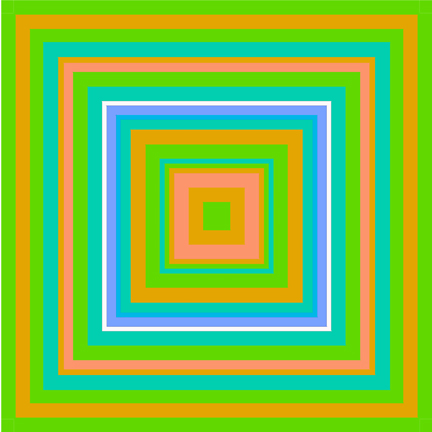
Equipoise try #2


My first try at a video that might show the joy of arranging colors didn't work out because I was not able to capture the screen in Photoshop the same way each time and presenting colors randomly was not visually satisfying.  So I decided to play a bit in Flash to see what might work there.
I didn't have a plan, just wanted to fool around to see some affects I have not tried before.
After a pretty short time I decided I liked the way the squares moved around and the way they came on to the screen but I definitely wanted to have a specific plan in the next attempt.
The music in this piece and yesterday's was chosen after I made the video just for fun.  It is music that I can use, as it is copyright free, a very nice feature.  I have a collection that I store in itunes and in this case I tried out those pieces that were the same length as my animation and found ones that seemed to be in the same spirit as the video.
Here is the the "play" video.
Tomorrow - the final version.