Monday, February 12, 2018

ALASKA #5

Alaska has few roads and most the these are in the Southern part of the state.  It is home to a unique feature, the Anton Anderson Memorial Tunnel, an active Alaska Railroad and road tunnel.  This tunnel is 2.5 miles, the longest road tunnel in North American until 2007 when the Ted Williams Tunnel was completed in Boston.

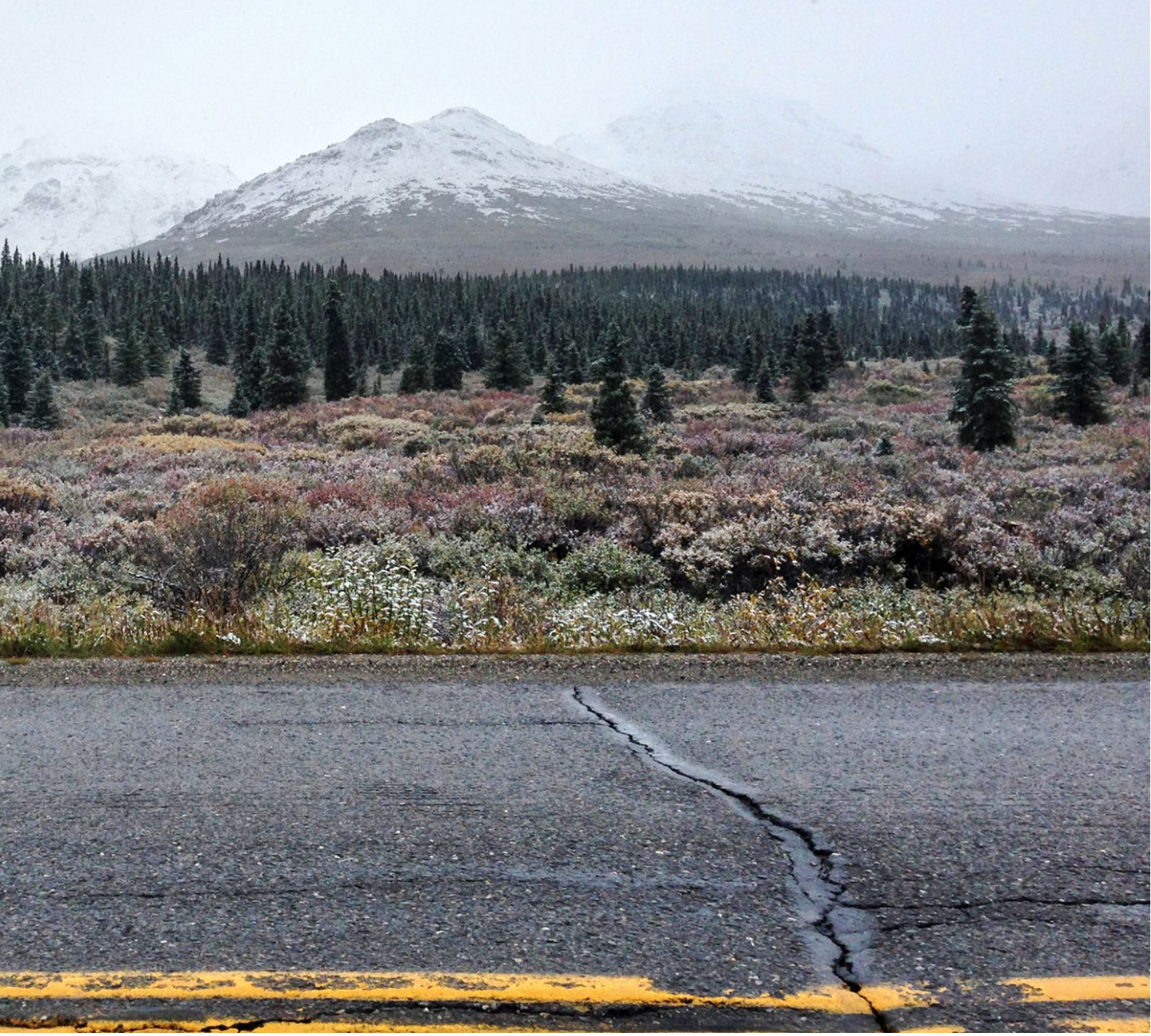
However trouble is brewing.  Apparently the permafrost is melting causing huge fissures in the few roads that do exist.  So the romantic trip through the last frontier may be marred by your car falling into the abyss.


Check out details HERE.


Saturday, February 10, 2018

ALASKA #4


There are very few roads in Alaska so traveling on Google maps is limited but today I took a trip on the Glen Highway in Glennallen which is in the Southeastern area of the State.

This from Wikipedia:

"During World War II, the United States built a series of military bases in Alaska, primarily for the purpose of supplying aircraft and other war materiel to Russia by way of Alaska and the Russian Far East as part of the Lend-lease program. This made it difficult for the Germans to the west and the Japanese to the south of Russia to interfere with the supply operation. As part of this operation, highways were built to supply the bases. The major highway project of this effort was the Alaska Highway from Dawson CreekBritish ColumbiaCanada to the existing Richardson Highway at Delta Junction, Alaska and thus to Fairbanks via the Richardson Highway. Another project was the Glenn Highway, which connected Anchorage, Alaska's largest city, with the Richardson Highway, and thus with the rest of Alaska, Canada, and the then-48 United States.[citation needed]"       

You can drive for miles and see nothing with a very occasional car passing by.


However I did spot this rest stop after many miles.


And, just as I was afraid I would run out of gas and die of hunger, a Grocery store and gas station.


Screen+Shot+2018-02-09+at+8.40.23+AM.png

I saw no billboards, no Drugstores, no MacDonalds or Wendy's on this highway.

Wednesday, February 7, 2018

ALASKA #3

The first people to arrive in Alaska seem to have traveled over the Bering Land Bridge around 16,500 years BC.  This land bridge no longer exists but it was from Beringia in Siberia to North America and the people who crossed the bridge were called Ancient Beringians.


The Tlingit people developed a society with a matrilineal kinship system of property inheritance and descent in what is today Southeast Alaska.


  Tsimshian are indigenous people also with a matrilineal kinship system in Southern Alaska.


The Haida tribe also in Southeast Asia is well known for its art as well it should be.  It is spectacular. I always wonder when seeing a body of work from one group that is so fabulous if one artist began working in that style and others simply seeing how exciting it was copied it, or if it actually pours out of the soul of a culture.


Contemporary Haida art looks like this and is called Haida Manga.


Tuesday, February 6, 2018

Slightly off topic

Considering that Alaska has very few people but a tremendous number of animals and plants I began to think about how each place where civilization developed was influenced by its very particular life forms.  This led to wondering about life itself and where and how it developed.

It seems that no-one really knows about that but HERE are some interesting conjectures.


If you are interested in the fascinating development of life on earth HERE is a good list.

Sunday, February 4, 2018

ALASKA #2

Alaska is home to the largest wildlife refuges in the United States, comprising 16 million acres.  Currently drilling for oil was approved for portions of ANWR, which is in North East Alaska and is a part of this national treasure.  Drilling is strongly opposed by environmental groups and Gwich'in Natives in Alaska and Canada who depend on the Porcupine Caribou Herd for their subsistence lifestyle.

This is what our President had to say about his reasons for including this legislation in the tax bill.


Friday, February 2, 2018

ALASKA

It's February and time to get on our anoraks and move on to the next state - ALASKA.  I guess Alabama and Alaska are about as different as you can get, at least as far as climate is concerned.  The average temperature of Alabama is 65, Alaska's is 37 but Alaska is so big that it actually spans three climate zones.


Alaska is by far our largest state.  Since it is located so far away and separated from the rest of the states it is not so obvious, but here superimposed on the rest of the states it is very clear just how big it is.


Sunday, January 28, 2018

ALABAMA #13

We have only a few days left to deal with the culture of Alabama.

Along with looking into the history of Alabama I read a book which was written about a small town in Alabama from the viewpoint of a young boy, A BOY'S LIFE by Robert McCammon.  I enjoyed the book very much.  I think it should be made into a series as there is something exciting happening regularly, enough for at least 20 episodes. The main character keeps his head on his shoulders as he is buffeted by life.  It deals with bullies of all ages, race relations in the south, fathers and sons, and a lot of fantasy.  A mystery ties the whole plot together.

"Zephyr, Alabama, is an idyllic hometown for eleven-year-old Cory Mackenson—a place where monsters swim the river deep and friends are forever. Then, one cold spring morning, Cory and his father witness a car plunge into a lake—and a desperate rescue attempt brings his father face-to-face with a terrible vision of death that will haunt him forever."....AMAZON

I have not seen the movie SELMA but I plan to.

Here are all the well known people who came from Alabama.

Wednesday, January 24, 2018

ALABAMA #12

The last big history making events in Alabama occurred in 1964 and 1965 with the Marches from Selma to Montgomery.  This is an interesting, heart wrenching story worth reading.  I chose Selma to paint and here is the finished work.  These are all old buildings that were undoubtedly around when the marches took place.  Half the purchase price of all my "state" paintings will go to the ACLU.


SELMA, ALABAMA
Nancy Herman
oil on stretched canvas
12' x 24"

$500.00


Our problems with bigotry and hatred have not gone away. There are always some people, who believe that they can identify a whole group of people by their color or their nationality as a threat.  When the real threat is the people who happen to be in power who subvert the law and use their power to benefit themselves and their buddies.

Here I am doing my own marching last Saturday in Philadelphia.


Tuesday, January 23, 2018

ALABAMA #11

The twentieth Century was marked by the gradual increase in the ability of African Americans to  vote but was hard won.  Alabama played a key role in slowing down the process with Governor George Wallace refusing to desegregate schools until the John F Kennedy sent in the  National Guard.  How brave those people were who faced the ugly hatred of their white neighbors!


Vivian Malone Jones arrives to enroll in classes at the University of Alabama


Dr. Sonnie Hereford and his 6 year old son return home
after being turned away from Huntsville's Fifth Avenue School
on Sept. 3, 1963.  Six days later, Sonnie Hereford IV became the first
black child enrolled at a public school in Alabama.

Monday, January 22, 2018

ALABAMA # 10

Last post I said that the Rosenfeld Fund built many schools in Alabama and then the link sent you to the ROSENWALD FUND which obviously was the correct name for the fund.  From now on my blog will be edited by someone who is more careful than I am.

A combination of agricultural depression caused by an infestation of the Boll Weevil, continued rational discrimination and lynchings led many African Americans to move (The Great Migration) to Northern and Mid Western states.  The population was depleted by nearly half.  Many of those remaining both black and white moved to Birmingham where heavy industry and mining employed over 30% of the states population.


Friday, January 19, 2018

ALABAMA #9

The new 1901 Constitution of Alabama effectively disenfranchised large portions of the population including nearly all African Americans, Native Americans, and tens of thousands of poor whites.  They did this by making voter registration very difficult, requiring a poll tax and a literacy test.  There were 181,000 African Americans eligible to vote in 1900 and only 2,980 in 1903.  These poll taxes in effect disenfranchised poor whites although they actually voted to pass the laws against their own self interest.
In addition most public facilities were segregated.
The Rosenfeld Fund provided millions of dollars to build and maintain schools for black children as the public funding was grossly inadequate.   There were a total of 387 schools built.


Thursday, January 18, 2018

Alabama #8

Alabama's slaves were freed by the 13th Amendment in 1865.  During the period from1867 to 1874 many African Americans emerged as political leaders in the state. Remember nearly half the population was African American.  Some sources including Wikipedia say that many whites were disenfranchised at this time but that 'fact' is disputed by other sources and seems not to have solid documentation.


What is known is that during Reconstruction state legislators ratified a new state constitution that created the states first public school system and expanded women's rights.  Public works were also funded constructing roads and railroads. 
This period of progress was ended with a new election in 1874.  These new elected officials passed legislation that racially segregated schools.  By 1901 most African Americans and many poor whites had been disenfranchised by the new constitution. 


Wednesday, January 17, 2018

Alabama #7


"By 1860, the population of Alabama had increased to 964,201 people, of which nearly half, 435,080 were enslaved African Americans, and 2,690 were free people of color.

On January 11,1861 Alabama declared its secession from the Union.  It joined the Confederate States of America soon thereafter.  The Confedracy's capital was initially at Montgomery.  Alabama was heavily involved in the American Civil War.  Although comparatively few battles were fought in the state, Alabama contributed about 120,00 soldiers to the war effort." ..   Wikipedia

Here is an interesting account of the war as it impacted Alabama.


Tuesday, January 16, 2018

Alabama #6

The territory that is now Alabama underwent many changes in its boundaries from the early settlements until it eventually became a state in 1819.  It also was "owned" by several countries.  After it became a state there was a great rush to settle there as the land was suitable for growing cotton and the slave trade made it possible to farm the cotton inexpensively.
And so begins the sad tale of slavery and how it forms and deforms the character of the people involved.

The area also drew many poor, disenfranchised people who became subsistence farmers.  Alabama had an estimated population of under 10,000 people in 1810 and 300,000 by 1830.

Most Native American tribes were completely removed from the state within a few years of the passage of the Indian Removal Act by Congress in 1830.


Monday, January 15, 2018

Alabama #6

After Europeans started flooding into Alabama.  The Indians living there became alarmed as their lands were being usurped.  Many were decimated by diseases brought by the settlers.  The Creek Indian tribe who occupied most of the territory were split in their allegiances.  Tecumseh, the great Shawnee leader, tried to unite the Creeks against the settlers who wanted the Indians to adopt trades in order to better serve their needs.

Spain and England sided with those waring in opposition to the settlements.  Andrew Jackson lead the settlers and was allied with Choctaw, Chickasaw, and Cherokee Creeks who were often of mixed blood with the settlers.  This was the first Indian war and was part of the War of 1812.


1899 Chromolithograph artist unkown


The Creek War ended in 1814 when the Creeks were forced to sign the Treaty of Fort Jackson, ceding some forty thousand square miles of land to the United States.  The Indians who fought with Jackson were also soon forced to cede their lands.  I wonder what would have happened had the Indians stuck together.

By 1830 the removal of almost all the native Alabamans was completed though a few did remain such as the Poarch Band of Creek Indians who somehow escaped and remain there today.


Saturday, January 13, 2018

Alabama #5


The first Europeans to arrive in Alabama were:  (From the History of Alabama Website)


1519:  Alonso Alvarez de Pineda led an expedition to the region
1528:  Cabeza de Vaca visited Alabama
1540:  Hernando de Soto led a Spanish expedition to the area.the Spanish when

DeSoto breezed through in 1540.  Apparently there was not a settlement of Europeans at that time but 160 years later the French created one in old Mobile which was later moved to the current site of Mobile.
After that history can best be described as a greedy land grab from one foreign country after another. The British took over from the French and then the land was divided between the British and the Spanish.

What happened to the original occupants of the area ?

This is from the Alabama Indian fact sheet for children:

"The record of the first contact with the Alabama comes from the DeSoto expedition in 1641.
Desoto found the "Alabama" tribe in central Mississippi and attacked and killed many of them in a fierce battle.  Later they moved east into present day Alabama where they lived at the junction of the Coosa and Tallapoosa Rivers.  Desoto also found the Coushata living on the Tennessee river.  By the 1780's the Americans wanted the land in Alabama and the Alabama were forced to move west across the Mississippi river into Louisiana around Opelousa.  Around 1803 they moved west again across the Sabine river into Northeast Texas.  They were settled in the region of the Hasinais Caddo Indians where they still live."

Friday, January 12, 2018


Indigenous people of varying cultures lived in the area including Alabama for thousands of years before the advent of European colonization.  Trade with the northeastern tribes began during the Burial Mound Period and continued until European contact.

In this period people were grouped in the Mississipian Culture which covers a great deal of the Eastern Coast.


Thursday, January 11, 2018

Alabama #4

Before we delve anymore into the history of Alabama it is probably a good idea to see exactly where it is.  If you are anything like me you have only a vague idea about this country's geography.  I knew Alabama was in the deep south but really hadn't realized it was as deep as you can get without falling into the Gulf of Mexico.

Tennessee is to the North, Mississippi is to the West, and Florida is to the South and East.  It will be interesting to see when we get to Florida how they managed to get that big hunk of land on the Gulf of Mexico that looks like it should be a part of Alabama.  The whole business of the borders between states must have been quite a political struggle!


There are some fine looking resorts on Alabama's Gulf of Mexico's shore.


Wednesday, January 10, 2018

Alabama #3

Thanks to a careful reader of this blog a gigantic mistake was detected in yesterday's data.  I said  there had been humans in the United States for over 1000 years.  I meant to refer to when the Indians built mounds at Moundville.  Actually there have been humans here for at least from between 10 and 20 thousand years ago.

Here is an interesting site that talks more about these fascinating mound structures and has some pictures of the art created there.


Tuesday, January 9, 2018

Alabama #2

This month I am dedicated to finding out whatever I can about Alabama in my quest to know my country better.  I started in December but the holidays got in the way.

I have been cruising around by way of Google maps and have a street in Selma to paint.  this is the screen grab I'm working from.


It is the poorest city in Alabama and perhaps because of that there are some nice old buildings.  No-one had the money to tear them down.

I have been delving with fascination into the history of Alabama.  I knew there were Indians in America but I had no idea that there were people in the United States at least 1000 years ago.  Christopher Columbus discovered America -  harrumph!  Several civilizations grew up and went into decline before Europe even officially put us on their map.

The agrarian Mississippian culture covered most of the state from 1000 to 1600 AD, with one of its major centers built at what is now Moundville Archaeological Site in Moundville, Alabama.  On Google maps cruising the streets of Moundville I came upon this mound.  What the mounds were designed for is not that clear but some in our country were as large as the Egyptian pyramids.  It seems the served different functions over the years.  Sometimes religious, sometimes secular and sometimes as burial grounds.  There were also homes situated on top of some mounds which leads me to wonder if they were not at least in part to make sure the house stayed dry in case the waters around the area got too high.  Here is a link to images from the museum there.


Tuesday, December 12, 2017

Alabama

Very important vote in Alabama today.

This is the way the vote went down for the President.  It is interesting to see that the Democratic votes are almost all outside the big cities but clustered together.  I will be riding those rides to see if I can tell how that happened.  Let's see how today's vote compares.
 https://www.politico.com/2016-election/results/map/president/alabama/

www.nancyherman.com

Tuesday, December 5, 2017

Mobile, Alabama #1

Well, the dust has settled on my new life and it is time to get back to work.  After going through all my art work and thinking about what is and is not of value to me into the future I have decided to work on some more pure color pieces in oil and try my hand at water colors again.  Both require drying time so I can alternate between the two.  More about that as I complete some pieces.

In the meantime I have been wondering quite a bit since the election about my country.  I have only visited a couple of states and since I really don't like to travel am unlikely to visit many more. I do like to travel around on Google maps, however, and I am curious.  What can be learned from simply traveling the roads?  I have decided to find out by visiting each state, in alphabetical order and spending a month there, all from the comfort of my sitting room in front of my MAC.  I plan to paint one piece for each state.

Yesterday I began with the roads leading out of Mobile, Alabama.  I found a road called Cottage Hill Road which sounded as if it would lead to something picturesque.  I spent at least 45 minutes on this road and those which followed.  Most of what I saw were shopping malls with CVS, WAWA, WELLS FARGO, TACO BELL , etc.  The housing was one story ranches surrounded by big lawns or developments with names like Quail Crossing.  There was no poverty or great wealth in evidence.  Nothing seemed older than 50 years at the most.  I saw one white person and one brown person and two horses.


Here is the only garden found although in the upscale homes there were definitely signs of lawn maintenance.


                                            This was the only sign of life and age.


This is how the trip felt to me.


In the Presidential election Mobile voted 55.62% for Trump and 42.01% for Clinton.


Friday, November 10, 2017

SHOP

Looking for the perfect inexpensive but fabulous gift for a child or teenager?  Check out my new SHOP for the holidays. You may find the perfect gift for a teacher, fellow worker or next door neighbor as well.

SHOP

Monday, November 6, 2017

LEAVES

Leaves
Every October it becomes important, no, necessary
to see the leaves turning, to be surrounded
by leaves turning; it’s not just the symbolism,
to confront in the death of the year your death,
one blazing farewell appearance, though the irony 
isn’t lost on you that nature is most seductive
when it’s about to die, flaunting the dazzle of its 
incipient exit, an ending that at least so far 
the effects of human progress (pollution, acid rain)
have not yet frightened you enough to make you believe
is real; that is, you know this ending is a deception
because of course nature is always renewing itself—
the trees don’t die, they just pretend,
go out in style, and return in style: a new style.


LEAVES
Nancy Herman
8" x 6"
oil on canvas board

$125.00

Sunday, November 5, 2017

TABLE FOR ONE


My painting TABLE FOR ONE is used for an article by SaraKay Smullens about, appropriately enough, eating alone.


https://www.huffingtonpost.com/entry/59fe5a78e4b0d467d4c225b2

Tuesday, October 31, 2017

Empty Street in Autumn


 This is my street, Latches Lane, where very often there are no cars.  How lucky I am to live here.


EMPTY STREET IN AUTUMN
Nancy Herman
6" x 8"
oil on canvas board


for sale on Dailypaintworks auction.


Monday, October 30, 2017

Merion Road and Sycamore St.

The colors of autumn have finally arrived in all their glory.  Even though the wind is trying its best to dislodge them today, they are still holding on to be sure they make a glorious send off of the year.  Here at Merion Road and Sycamore there is always a fine display.


MERION AND SYCAMORE
6' x 8"
oil on canvas board
Nancy Herman

auction at Dailypaintworks


Tuesday, October 10, 2017

REACHING


I love the way trees reach for the sky.  Their roots search for water and nutrients and the tips of their branches move eagerly towards the light as they search for their most majestic height.  The natural world tells us everything we need to know about living.


REACHING
Nancy Herman
12" x 9"
Oil on Stretched Canvas

This painting is being auctioned off on DailyPaintworks.  Click here to bid.


Thursday, October 5, 2017

ART CRITICISM

While cleaning out my entire house (4 floors, including basement).  I found a lot of old art and old writing and have decided to write the story of my life with pictures as I produced them for my grandchildren and great grandchildren.  This is a sample that I have changed a bit for the blog.  Unfortunately I don't have the picture described but I do have a small water color that probably came from that time.


ART CRITICISM


FRUIT AND BOTTLE
water color and pencil
Nancy Henrich


When I was around 6 or 7 I took a painting class at the local library.  It was taught by an enthusiastic young man who took a special interest in my "work".  I think I was pretty good at watercolors and able to get the way things looked, sort of, with not too much messiness. This has to be unusual for a child that age.  He insisted I have a "one girl show" at the library to celebrate my “genius” as the local newspaper put it. In that show there was a landscape with only the head of a horse in the middle.  My enthusiastic teacher, who was probably just a young art student, said this was part of my talent. Meaning that I was free to put just the head of the horse in the picture because I knew that was all that was necessary to indicate “horseness”.  I thought that I had only included the head because I had no idea  how to draw the rest of the body.  I didn’t tell him that.  I liked his idea better.I think this small incident pretty much defines for me everything there is to know about what other people think an artist is about and how that influences what artists say to other people about what they do.
But, suppose he was right.   It certainly is true that children, if they have not been overly praised or scolded about their art are freer to do what they want to than they will be as they learn more about what "art" is.  It is also true that the head of a horse does indicate "horsiness" and I felt free to put it in the painting without the body, even though I would have included the body if I knew how to draw it. When an artist in full control of the power of expression chooses to leave something key out of their work to create a certain feeling, that is art.  When someone simply doesn't know how to draw and so only includes what they can do comfortably...not so sure.  A lot of outsider art has this feel to it and often it is very moving.  If this concept is to hold water then art education is a big mistake and everything that is taught except how to wield a brush or sharpen a pencil leads to the burying of "talent".  
What do you think?